

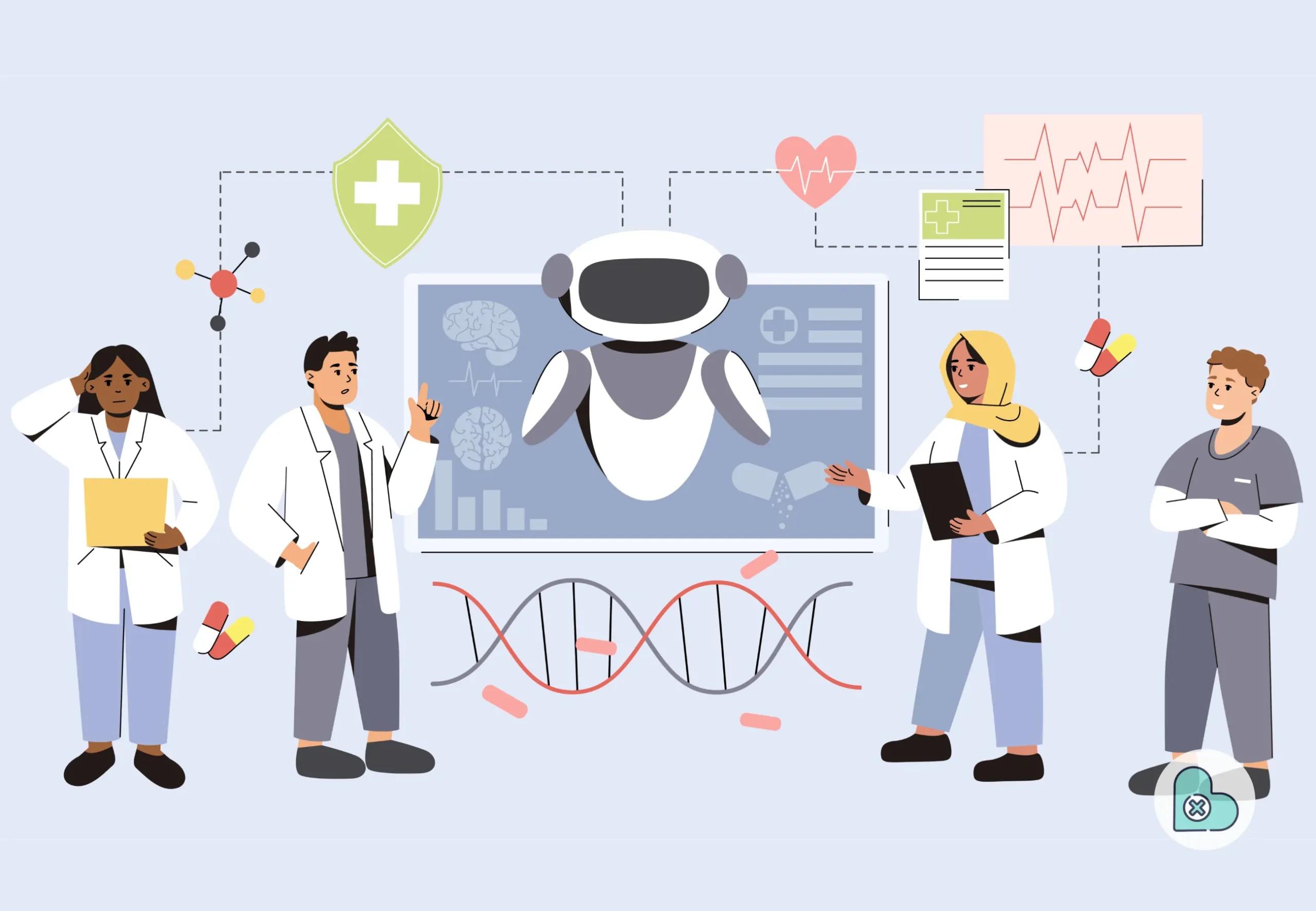
Healthcare is under pressure from every side right now.
Doctors are dealing with more patients. Teams are short-staffed. And behind the scenes, there’s a whole other layer claims, approvals, scheduling—that just keeps getting more complicated.
Here’s the surprising part…
Even simple tasks like booking an appointment or submitting a claim take way longer than they should. Not because they’re hard but because they’re scattered across systems, teams, and processes.
That’s where things start to break.
Too much of healthcare still depends on people chasing updates, checking multiple tools, and manually connecting the dots. Over time, it slows everything down and adds unnecessary stress.
This is exactly where AI agents in healthcare are stepping in.
They’re not here to replace people. They’re here to keep work moving when things get stuck.
What Is an AI Agent in Healthcare?

_ DC Studio _ freepik
Let’s keep this simple. If you’re wondering what an AI agent in healthcare is, think of it like a smart assistant that doesn’t just give answers—it takes action.
An AI agent can:
- Understand what’s happening
- Make decisions
- Perform tasks on its own
In healthcare, that means working with data like patient records, lab results, claims, and schedules.
But here’s what makes it different from regular automation. A basic system follows rules: if this happens, do that.
An AI agent? It adapts.
It considers context, determines the best next step, and executes it—even if the situation changes. That’s the real AI agent definition healthcare teams are starting to rely on.
How Healthcare AI Agents Actually Work

_ DC Studio _ freepik
Now you might be thinking—okay, but what does that look like in real life?
Let’s take a simple example.
A claim gets denied.
Instead of a person manually reviewing it, healthcare AI agents can:
- Read the denial reason
- Identify missing documents
- Gather the required information
- Prepare the corrected submission
And if approval is needed, it routes everything to the right person—without delays.
Another example?
A patient’s wearable device shows unusual data. The system picks it up, checks medical history, and alerts the care team before things get serious.
That’s not just automation. That’s decision-making in action.
The Core Structure Behind AI Agents
Most AI agents in healthcare use a simple yet powerful architecture.
You can think of it as a continuous cycle:
- Planning – identifying what needs to be done
- Action – actually doing the task
- Reflection – checking if it worked
- Memory – learning from it for next time
This setup enables AI-powered healthcare systems to handle complex workflows without constant human input. And this is where it really starts to get interesting.
Because healthcare isn’t just one task—it’s a chain of connected steps. And these agents can manage that chain from start to finish.
Why This Matters More Than Ever

_ stockking _ freepik
Here’s the truth—healthcare doesn’t just need more people. It needs better systems. With growing demand and limited staff, teams can’t afford to spend hours on repetitive tasks.
That’s why healthcare automation solutions powered by AI are becoming essential.
They help:
- Reduce manual workload
- Improve speed and accuracy
- Keep processes moving without delays
And most importantly, they give healthcare professionals something they’re seriously short on—time.
AI in Healthcare: 10 Real Use Cases That Are Quietly Fixing Broken Systems
Let’s be honest—healthcare doesn’t always feel smooth. There’s always something slowing things down. Long calls. Repeated questions. Paperwork that never seems to end. And if you’ve ever worked inside a hospital, you already know this isn’t about people not doing their jobs well. It’s about systems that haven’t kept up.
That’s exactly where AI in healthcare is starting to make a real difference. Not in a dramatic, futuristic way. But in small, practical ways that remove friction from everyday work. And more importantly, AI agents in healthcare are quietly stepping in to handle the repetitive, time-consuming tasks that no one really wants to deal with—but everyone has to.
Let’s walk through real use cases that show how this shift is actually happening.
Use Case 01 – Employee Self-Service and Internal Support
The problem
Within healthcare organizations, support teams such as HR, IT, billing, and operations handle a constant flow of requests. But here’s the catch—many of these requests still rely on phone calls or basic ticketing systems.
So what happens?
People wait on hold. They repeat the same issue multiple times. And even then, not every problem gets solved on the first attempt. For someone in a clinical role, that delay is more than frustrating—it directly impacts their time with patients.
How AI agents help
This is where AI agents in healthcare start making a noticeable difference.
Instead of logging a ticket and waiting, the system understands the request and acts on it.
Let’s say a clinician notices a patient’s claim is on hold. The AI agent doesn’t just record it. It:
- Pulls data from the EHR
- Checks payer requirements
- Identifies missing details
- Fixes or resubmits the claim
If human approval is needed, it routes the case with full context already attached. No chasing updates. No repeated follow-ups.
The result
- Faster resolutions
- Less internal back-and-forth
- Reduced wait times
- More focus on patient care
Use Case 02 – Smarter Clinical Documentation with AI
The problem
Clinical documentation is one of those things that quietly eats up time. Doctors now spend over 13.5 hours a week on it. That’s a lot of evenings and weekends lost to screens.
Switching between patient conversations and typing notes… it breaks the flow. It slowly leads to burnout.
How AI agents help
This is one of the strongest areas where AI agents in healthcare are making an impact. Instead of documenting everything later, AI works alongside the clinician in real time.
During a consultation:
- It listens (with consent)
- Captures key medical details
- Structure the information correctly
- Updates records automatically
Another layer checks for missing or inconsistent information before finalizing the note. So instead of starting from scratch, the clinician reviews, edits if needed, and approves.
The result
- Significant time savings
- Less after-hours documentation
- Better accuracy
- Reduced burnout
Use Case 03 – Care Team Coordination and Handoffs
The problem
Healthcare involves multiple people—doctors, nurses, specialists, labs, and admin teams. But coordination between them? Still very manual.
Things depend on notes, emails, or someone remembering to follow up. And when something is missed, delays happen.
How AI agents help
With AI care coordination, things start to move more smoothly.
For example, when a patient is ready for discharge:
- AI tracks the discharge order
- Schedules follow-ups
- Checks provider availability
- Notifies the right teams
It also verifies that all documentation and prescriptions are complete before the patient leaves. If something is missing, it flags it immediately.
The result
- Fewer delays
- Better coordination
- Improved patient flow
- More efficient use of resources
Reimagining Patient Experience
Now think about healthcare from a patient’s perspective.
It often feels confusing—there are too many steps. Too much waiting. Too many repeated questions.
This is where the experience really needs to improve—and it’s exactly where AI agents in healthcare are helping quietly in the background.
Use Case 04 – Patient Scheduling and Intake
The problem
Most appointments are still booked by phone. Which means long wait times, scheduling errors, and a high chance of missed appointments.
How AI agents help
AI turns scheduling into a simple, connected process.
Patients can:
- Book appointments through chat or voice
- See available slots instantly
- Get confirmations without waiting
Then another system collects intake information before the visit. If plans change, rescheduling happens automatically.
The result
- Reduced front-desk workload
- Better-prepared patients
- Fewer no-shows
Use Case 05 – Billing, Claim Status, and Financial Assistance
The problem
Billing is often the most confusing part of healthcare. Patients don’t always understand what they owe or why. And getting answers usually means calling support.
How AI agents help
With AI support for medical billing, patients can get answers instantly.
They can:
- Check claim status
- Understand bills in simple language
- Explore payment options
If financial assistance is available, the system guides them through it.
And if something needs human attention, it’s passed along with full details.
The result
- Faster answers
- Less confusion
- Fewer repetitive calls
Use Case 06 – Reminders and Follow-Ups
The problem
Missed appointments remain a major issue. They waste time, delay care, and affect overall efficiency.
How AI agents help
AI handles reminders more effectively. Instead of generic messages, it:
- Sends reminders at the right time
- Shares preparation instructions
- Follows up after visits
If something is missed, it nudges again—without being annoying.
The result
- Better attendance
- Improved patient engagement
- Less manual work for staff
Use Case 07 – Personalized Self-Service Across Channels
The problem
Patients switch between chat, calls, and email. But systems often don’t carry context across these channels. So people end up repeating themselves.
How AI agents help
AI keeps track of the conversation—no matter where it started. So whether a patient:
- Starts on chat
- Moves to a call
- Follows up later
The system continues from where they left off.
The result
- Faster support
- More personalized experience
- Reduced workload for teams
Core Operations: Where AI Makes a Bigger Impact
Beyond patient experience, there’s another layer—operations. And honestly, this is where the real efficiency gains happen.
Use Case 08 – Claims Management and Denial Reduction
The problem
Claims processing is complex and often manual. Errors happen. Claims get denied. And fixing them takes time and money.
How AI agents help
With AI in claims processing, everything becomes more proactive.
AI:
- Reviews claims before submission
- Checks for missing details
- Aligns with payer rules
- Tracks status automatically
If something goes wrong, take corrective action or escalate.
The result
- Fewer denials
- Faster reimbursements
- Improved financial performance
Use Case 09 – Provider Onboarding and Credentialing
The problem
Onboarding new providers can take weeks—or even months. There are multiple checks, verifications, and approvals involved.
How AI agents help
AI streamlines the entire process.
It:
- Collects documents
- Verifies credentials
- Tracks progress
- Flags missing information
Everything moves forward without constant follow-ups.
The result
- Faster onboarding
- Less manual work
- Providers can start sooner
Use Case 10 – Billing and Payment Management
The problem
Even after claims are approved, payments can be messy. There are mismatches, delays, and manual reconciliation tasks.
How AI agents help
This is another area where AI agents in healthcare quietly improve operations.
AI:
- Matches payments with claims
- Detects discrepancies
- Updates balances
- Generates clear statements
No more endless comparisons between systems.
The result
- Faster payments
- Fewer errors
- Better financial clarity
Final Thought
Here’s the truth. Healthcare doesn’t need more tools—it needs better systems. And that’s exactly what AI agents in healthcare are helping build.
They’re not replacing doctors or staff. They’re removing the friction around them. The waiting. The repetition. The unnecessary work. And when that disappears, everything else starts to feel… easier.
Better for teams. Better for patients. And honestly, that’s the kind of change healthcare has needed for a long time.




Leave a Reply