


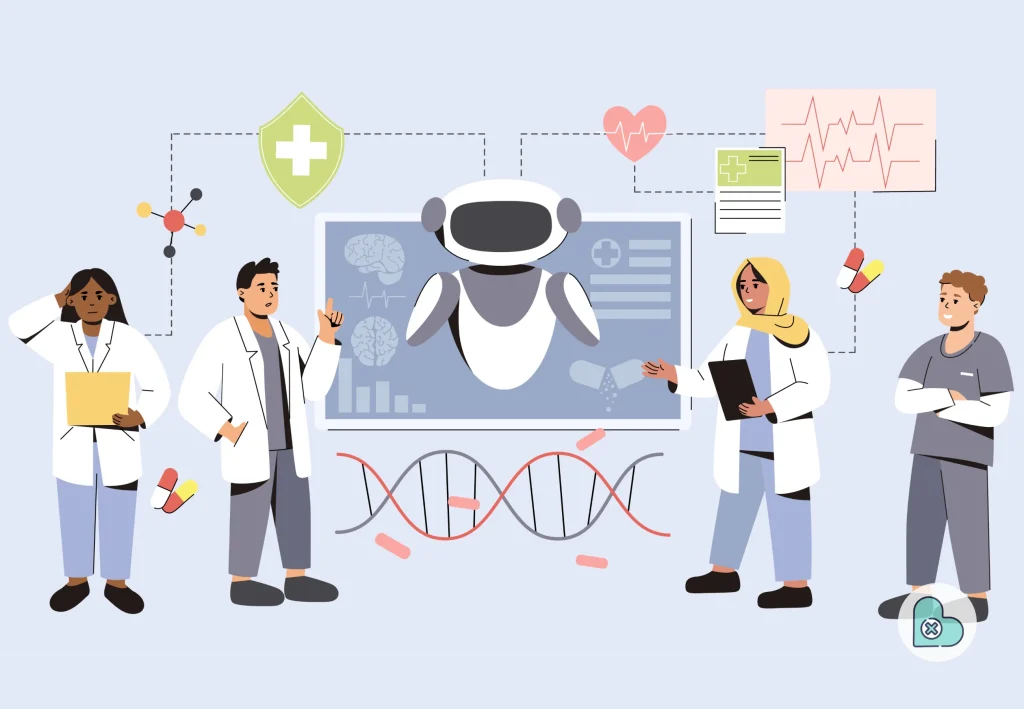
Agentic AI is a new type of artificial intelligence in healthcare. It helps systems work on their own. It uses intelligent agents that can think, act, and decide the next step. These AI agents support doctors by handling complex tasks. This makes agentic AI in healthcare an essential part of healthcare AI technology today.
Right now, agentic artificial intelligence is still new. Very few companies used it in 2024. But this will change fast. The Gartner agentic AI prediction says usage will grow to 33% by 2028. Reports also show the global agentic AI market size may reach nearly $200 billion by 2034. This shows a strong future of AI in healthcare.

What Is Agentic AI?
Agentic AI refers to AI systems that can act without constant human intervention. These systems include many autonomous AI agents. Each agent has a small role. Together, they form an AI agent framework.
According to IBM’s definition of agentic AI, it runs within an AI digital ecosystem. It works using large language models (LLMs), machine learning (ML), and natural language processing (NLP). These tools help agents understand data and language. Data quality matters a lot. Better data leads to better results.
How Agentic AI Is Used in Healthcare
Agentic AI used in healthcare helps with daily medical work. It supports clinical AI agents that review reports and patient data. It also helps manage AI-powered clinical workflows. This saves time for doctors and nurses.
Common uses include:
- Medical AI agents that support diagnosis
- Healthcare automation AI for scheduling and records
- AI decision support systems for safer choices
- AI agents in medical decision making
These tools improve care and reduce manual work.

Limits of Agentic AI
Even with progress, agentic artificial intelligence is still artificial narrow intelligence (ANI). It cannot think like humans. Accurate artificial general intelligence (AGI) has not yet been created.
Experts from UiPath healthcare AI say agents still depend on instructions and models. The limitations of agentic AI remind us that humans remain in control. Still, this is a big step in healthcare AI innovation and next-generation healthcare technology.
Agentic AI supports people. It does not replace them. It helps healthcare work better, faster, and smarter.
How Does Agentic AI Work in Healthcare?

Agentic AI is a new type of technology used in healthcare. It helps systems work by themselves. In simple words, agentic artificial intelligence uses innovative software to complete tasks without constant human help. These systems use healthcare AI agents to read data, think, and act. That is why agentic AI in healthcare is growing fast and becoming part of healthcare AI technology.
Hospitals deal with many tasks every day. Doctors check patients. Nurses manage care. Admin teams handle records and billing. This creates pressure and delays. Agentic AI used in healthcare helps reduce this burden. It supports people, not replaces them. These AI agents in healthcare quietly work in the background to improve daily operations.
At the centre of agentic AI is a group of tools. This includes tools like large language models (LLMs), machine learning (ML), and natural language processing (NLP). Together, they form an AI digital ecosystem. This system allows intelligent agents to understand data and take action. This setup follows the IBM agentic AI definition and supports safe healthcare use.
How Agentic AI Helps Healthcare Systems

Healthcare AI agents help in many medical areas. One key area is medical research. Scientists use AI for drug discovery to test many chemical compounds quickly. This allows them to find new treatments faster. It also supports AI for therapeutics development and AI compound screening.
Clinical trials also benefit from agentic AI. These trials test new drugs on patients. Medical AI agents help researchers find the right patients. They also monitor patient responses. This makes trials safer and faster. It supports AI in clinical trials and AI-optimised clinical trials.
Insurance work is another big challenge. Hospitals face many claim rejections. Agentic AI can review insurance denials. It compares old cases and drafts appeals. This improves approval rates. It helps through AI for insurance denial management and AI for insurance claims.
Doctors also get support from clinical AI agents. These agents read patient charts. They help with AI in clinical referrals and diagnosis. They use AI reasoning systems and multistep medical problem-solving to suggest care options.
Some intelligent healthcare agents act as a virtual health assistant AI. They monitor patient data. They send alerts and reminders. This includes AI for patient monitoring and AI for medication reminders. This helps patients stay on track with care.
Reducing Hospital Costs with Agentic AI

Hospitals spend a lot on administration. Reports show that over 40% of hospital costs are attributable to administrative work. Healthcare automation AI helps reduce this cost. Enterprise agentic AI handles many back-office tasks.
Hospitals must manage staff, salaries, beds, supplies, and quality checks. Autonomous AI agents study this data together. They suggest better ways to manage resources. This helps with AI in hospital administration, AI for staffing optimisation, AI for bed utilisation, and AI inventory management in healthcare.
This makes hospitals more efficient. Staff spend less time on paperwork. They spend more time on patient care. Autonomous decision-making AI helps leaders make faster and better choices.
Essential Points for Healthcare IT Leaders
Because agentic artificial intelligence can act autonomously, data security is crucial. Healthcare IT leaders’ AI teams must control data access. This is called AI data governance in healthcare.
For example, healthcare AI agents may use AI electronic health records (EHR). But they should not read private emails or messages. This protects patient privacy. It also supports healthcare data security, AI, and AI compliance.
Experts from UiPath’s healthcare AI say data must be carefully separated. This avoids misuse. It also helps manage the limitations of agentic AI.
Many hospitals already work with tech vendors. These vendors now add AI agent framework tools to their platforms. This makes adoption easy. It also increases the adoption of AI agents across healthcare systems.
Main Applications of Agentic AI in Healthcare
1. Automating Administrative Work
Administrative tasks are essential but slow. Manual work causes errors and delays. Agentic AI improves speed and accuracy.
It helps with:
- AI appointment scheduling for healthcare
- AI documentation automation
- AI for billing and claims processing
- AI for insurance claims
- Healthcare process automation
- AI-powered clinical workflows
This reduces workload and saves money.
2. Medical Imaging Support
Medical images help doctors detect disease. But image analysis takes time. AI medical imaging enhancement makes this easier.
Agentic AI improves image quality. It removes noise and sharpens scans. It supports AI image analysis for healthcare, AI noise reduction, and AI super-resolution imaging.
It also helps with:
- Automatic image segmentation
- AI pathology prediction
- AI clinical decision support imaging
- Support for AI in personalised medicine
This helps doctors make faster decisions.
3. Drug Discovery and Development
Developing drugs takes many years. Agentic AI speeds up this process. It supports AI for drug discovery by analysing data quickly.
It helps with:
- Finding drug targets
- Designing compounds
- Checking drug interactions
- Improving drug safety
- AI biomarker discovery
- AI drug repurposing
This reduces cost and failure risk.
4. Medical Research and Data Analysis
Medical research uses large datasets. AI data analysis in healthcare helps manage this data. Agentic AI supports AI in medical research by finding functional patterns.
It uses NLP in healthcare AI to read studies. It summarises long research papers. It also tracks trends and predicts outcomes.
This uses machine learning ML in healthcare, large language models LLMs in healthcare, and a secure AI digital ecosystem.
5. Pandemic Risk and Preparedness
Pandemics need early warning. AI risk prediction in healthcare helps spot threats early.
Agentic AI supports:
- AI outbreak detection
- AI predictive analytics healthcare
- AI vaccine development
- AI healthcare supply chain planning
- AI public health communication
- AI resource allocation in healthcare
This helps save lives.
6. Personalised Medicine
Personalised medicine focuses on individual patients. Agentic AI supports AI genomics analysis and AI pharmacogenomics. It studies genetic data. It helps doctors choose the right medicine. It also explains complex data in simple terms.
This strengthens AI-based medical intelligence and supports autonomous healthcare systems.
Future Trends in Agentic AI for Healthcare
Agentic AI is changing healthcare in a simple, helpful way. It helps doctors work more quickly and make better decisions. With agentic artificial intelligence, healthcare systems can analyse data, think step by step, and act autonomously. This makes daily work easier. Because of this, the future of agentic AI looks very bright. Today, agentic AI used in healthcare is improving care quality and saving time for everyone.
Faster and Smarter Drug Discovery
Agentic AI in healthcare helps scientists find new medicines quickly. AI can scan extensive medical data in minutes. This supports AI for drug discovery and AI compound identification. It also helps with AI drug interaction prediction. As a result, research takes less time and costs less money. Patients receive new, safer treatments sooner.
Better and Safer Surgeries
AI used in healthcare is also improving surgeries. AI in robotic surgery helps doctors perform accurate operations. These systems support AI-assisted surgery and precision surgery AI. More minor cuts mean less pain and a faster recovery. This improves AI-assisted surgical accuracy and reduces post-surgical health risks.
Personalised Care for Every Patient
Every patient is different. Personalised healthcare AI makes treatment fit each person. With AI in genomics, doctors better understand a patient’s body. This supports precision medicine AI and tailored treatment AI. Predictive healthcare AI can also find health problems early. This helps doctors give the proper care at the right time.
Real-Time Health Tracking
Real-time disease monitoring AI tracks health data daily. It helps with AI disease outbreak prediction and AI public health monitoring. This improves AI pandemic preparedness. Health teams can act early and protect more people.
Virtual Help Anytime
Virtual health assistant AI gives support day and night. These tools offer AI symptom tracking and AI mental health support. They also help with AI telehealth assistants. This improves AI healthcare accessibility, especially in remote areas.
Next Steps with Agentic AI
Smart healthcare agents and intelligent agents support hospitals every day. Autonomous AI agents help automate healthcare processes. They improve AI-powered clinical workflows and focus on patients. With decision intelligence healthcare, care becomes more personal. Agentic workflows in healthcare are shaping a safer and brighter future.




Leave a Reply